III.I.4 Neuraxial anesthesia: spinal
Regional
Spinal anesthesia
Where the drug goes, how high the block climbs, and what to do when it climbs too high.
By the end you can
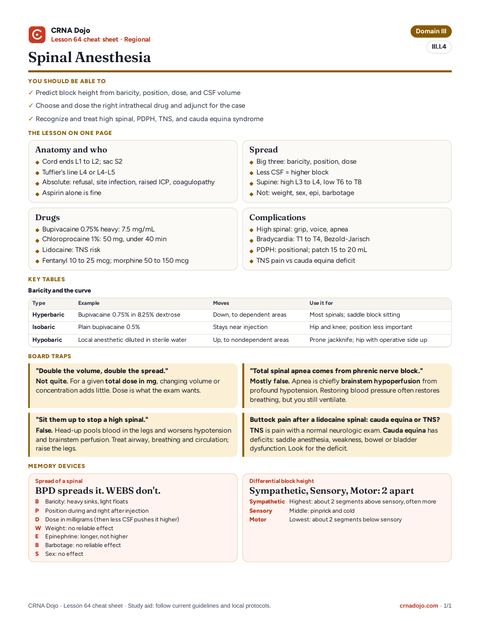
- Predict block height from baricity, position, dose, and CSF volume
- Choose and dose the right intrathecal drug and adjunct for the case
- Recognize and treat high spinal, PDPH, TNS, and cauda equina syndrome
Your case
OR 6 · TURP · 8 min after the spinal
Mr. R, 71, 80 kg. Takes aspirin 81 mg daily. You placed a spinal at L3-L4 sitting: hyperbaric bupivacaine 0.75%, 12 mg. He went supine, then into lithotomy.
Now he yawns and says he feels a little queasy.
BP 84/48
HR 48
SpO2 97%
Sensory level T6
Hold that thought
- What level does a TURP need, and why did this block go higher?
- Why is his heart rate falling, and what do you give?
- Should the aspirin have stopped you from doing a spinal?
You will answer these at the end of the lesson.
Members only
The rest of this lesson is for members
Membership opens all 98 lessons, every cheat sheet and memory card, the full question bank, and simulation exams.
Not ready to join? Free account: take the 50-question diagnostic, see your weakest domain, and get a study plan built around your exam date. No card.
Start free
Free for everyone
Inside this lesson
- Start
- The case
- The needle path
- Who gets a spinal
- Baricity and the curve
- What moves the block
- Block height simulator
- Local anesthetics
- Adjuncts
- Physiology
- High spinal
- Postdural puncture headache
- Neurologic complications
- Mnemonic
- Board traps
- Cheat card
- 5-question quiz
- Wrap-up