III.I.1 Regional anatomy
III.I.2 Infiltration
III.I.3 Topical
III.I.7 Ultrasound and nerve stimulator
Regional anatomy and principles
The map under every block: which fibers go numb, where the needle travels, and how high the block has to reach.
By the end you can
- Name the nerve fiber types and predict the order of differential block
- Trace the needle from skin to CSF and place the cord and dural sac in adults and infants
- Match a surgery to its dermatome level, and pick sound infiltration, topical, ultrasound, and nerve stimulator settings
Your case
OR 6 · TURP · 8 min after spinal
Mr. R, 74, 82 kg. Hyperbaric bupivacaine given sitting, at the interspace level with the top of the iliac crests.
You test the block. Cold is lost at T8, pinprick at the umbilicus, and light touch just above the groin. His legs are dense.
BP 94/52
HR 56
SpO2 97%
Pinprick T10
Hold that thought
- Is a T10 pinprick level enough for a TURP?
- Why are the cold, pinprick, and touch levels different, and why did his pressure fall?
- Which interspace did you likely use, and why is it safe from the cord?
You will answer these at the end of the lesson.
Members only
The rest of this lesson is for members
Membership opens all 98 lessons, every cheat sheet and memory card, the full question bank, and simulation exams.
Not ready to join? Free account: take the 50-question diagnostic, see your weakest domain, and get a study plan built around your exam date. No card.
Start free
Free memory card
Save it to your phone or print it.
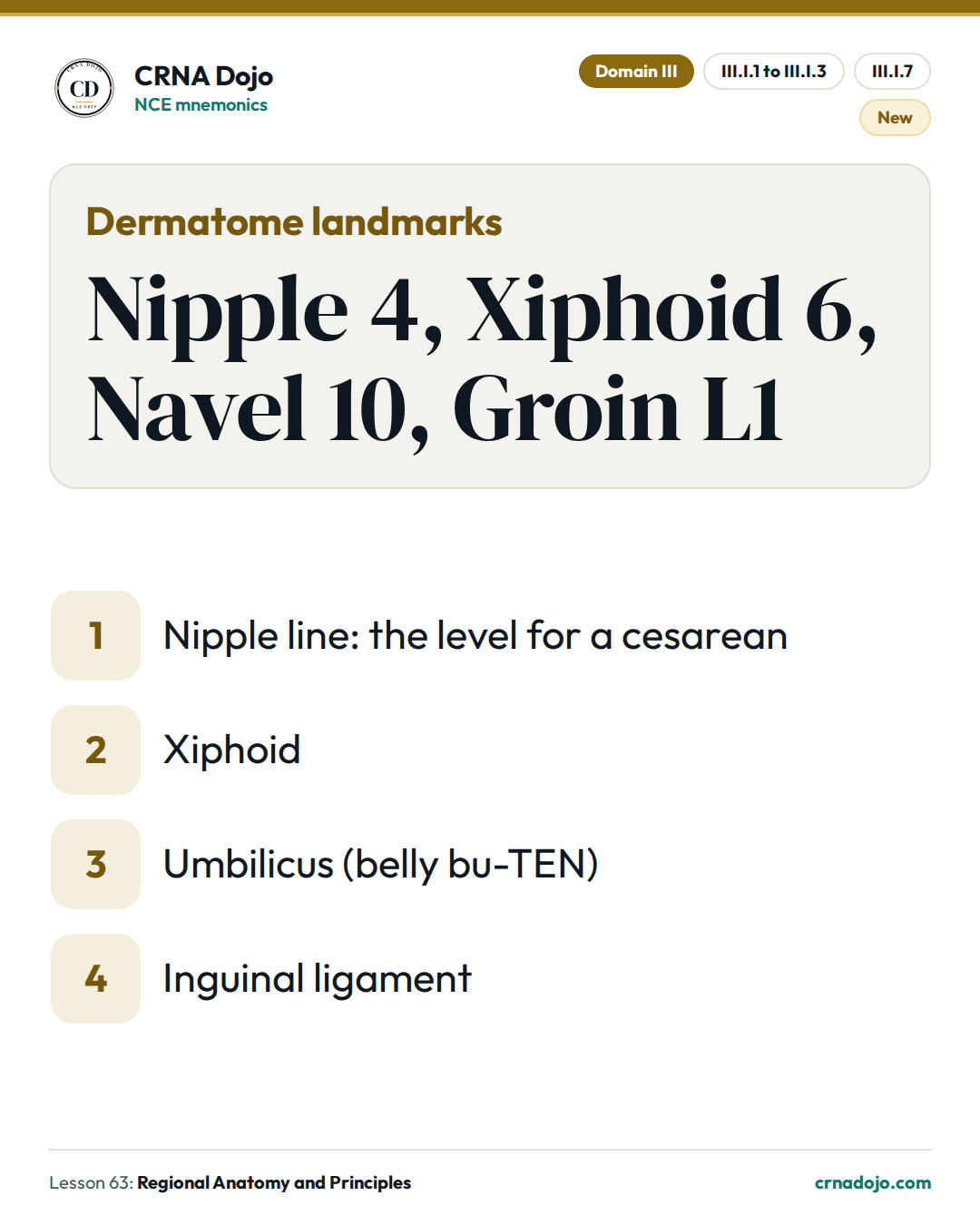
On a phone: press and hold a card, then tap Save to Photos.
Inside this lesson
- Start
- The case
- Nerve fibers
- Differential block
- The spinal column
- Needle path
- Where the cord ends
- Dermatome landmarks
- Dermatome map
- Practice: levels
- Infiltration and topical
- Ultrasound
- Nerve stimulator
- Mnemonic
- Board traps
- Cheat card
- 5-question quiz
- Wrap-up