I.C.5 Local anesthetics
I.C.6 Lipid emulsion
Local anesthetics and lipid emulsion
How local anesthetics block nerves, how much you can safely give, and how to rescue a patient when the level gets too high.
By the end you can
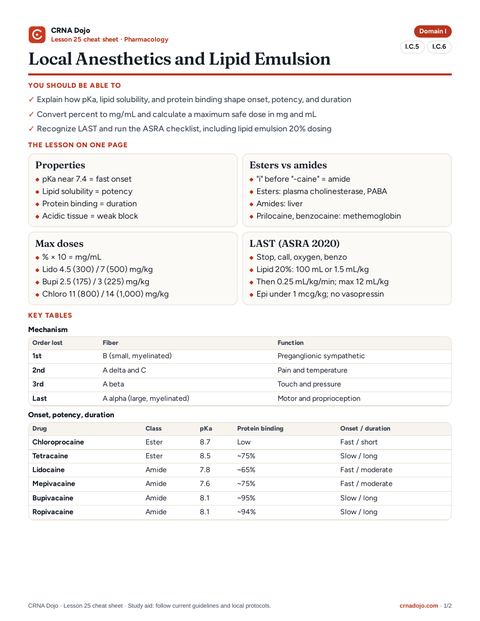
- Explain how pKa, lipid solubility, and protein binding shape onset, potency, and duration
- Convert percent to mg/mL and calculate a maximum safe dose in mg and mL
- Recognize LAST and run the ASRA checklist, including lipid emulsion 20% dosing
Your case
Block room · Bilateral TAP blocks · 12 min after injection
Mrs. K, 71, 60 kg, frail, for open hernia repair. Bilateral TAP blocks with 40 mL of bupivacaine 0.5% (20 mL per side), plain.
She says her lips feel numb and there is a metallic taste. Thirty seconds later she stops answering and has a generalized seizure. The ECG shows a widening QRS.
HR 48
BP 78/40
SpO2 91%
QRS wide
Hold that thought
- Was that bupivacaine dose over the limit?
- What do you give first for the seizure?
- How much lipid emulsion, and how fast?
You will answer these at the end of the lesson.
Members only
The rest of this lesson is for members
Membership opens all 98 lessons, every cheat sheet and memory card, the full question bank, and simulation exams.
Not ready to join? Free account: take the 50-question diagnostic, see your weakest domain, and get a study plan built around your exam date. No card.
Start free
Free for everyone
Free memory card
Save it to your phone or print it.
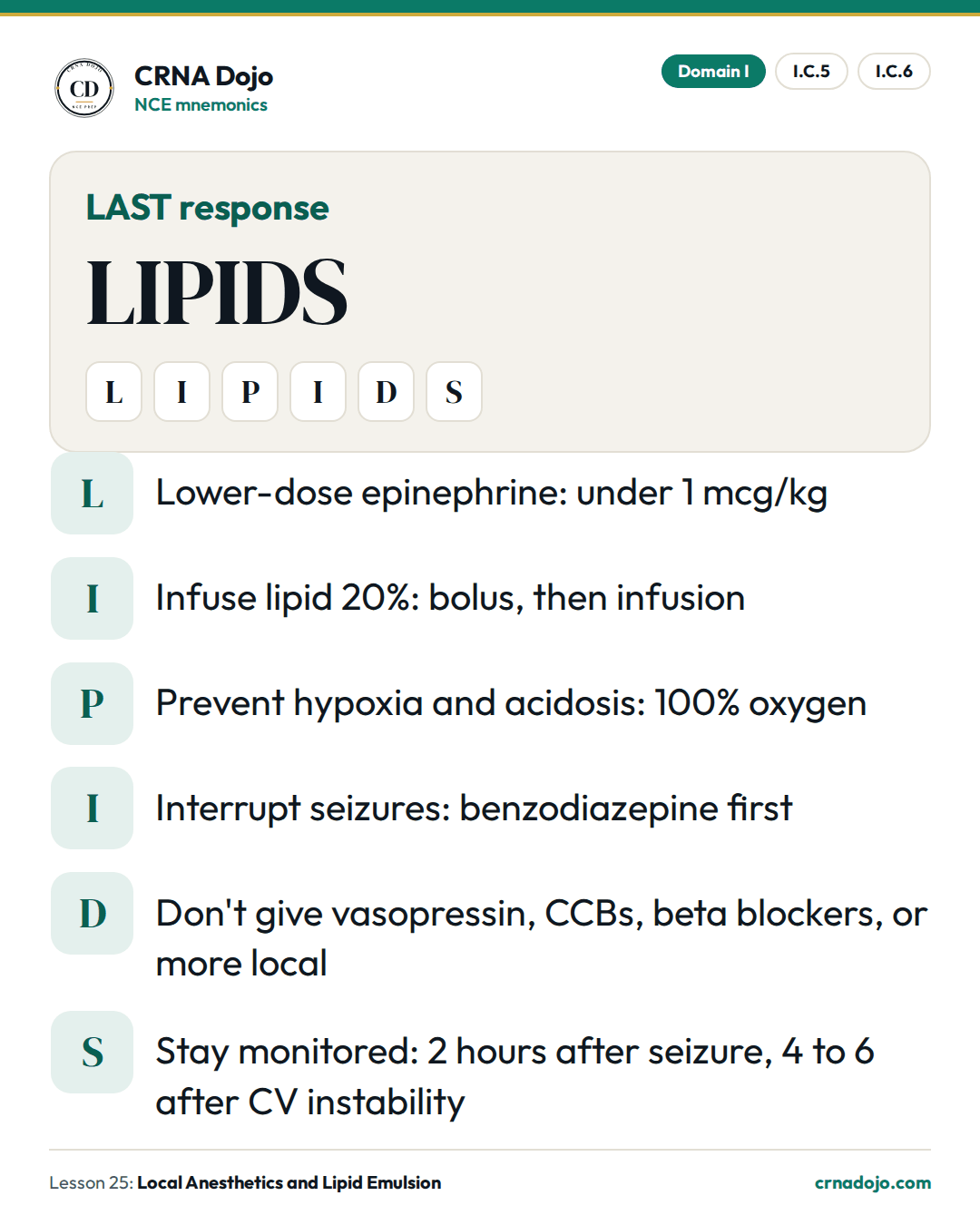
On a phone: press and hold a card, then tap Save to Photos.
Inside this lesson
- Start
- The case
- Mechanism
- The molecule
- Onset, potency, duration
- Esters vs amides
- Percent math
- Max-dose calculator
- Drug personalities
- Recognizing LAST
- Treating LAST
- Lipid emulsion
- Rapid fire
- Mnemonic
- Board traps
- Cheat card
- 5-question quiz
- Wrap-up