II.C.3 Capnography and oximetry
II.C.3 Gas analyzers
ASA basic monitoring standards
Capnography, oximetry, and gas analysis
What the airway gas monitor and the oximeter actually measure, and what every shape on the screen is trying to tell you.
By the end you can
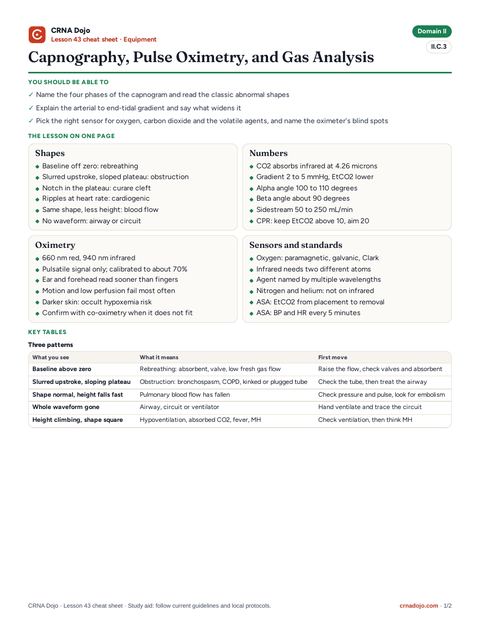
- Name the four phases of the capnogram and read the classic abnormal shapes
- Explain the arterial to end-tidal gradient and say what widens it
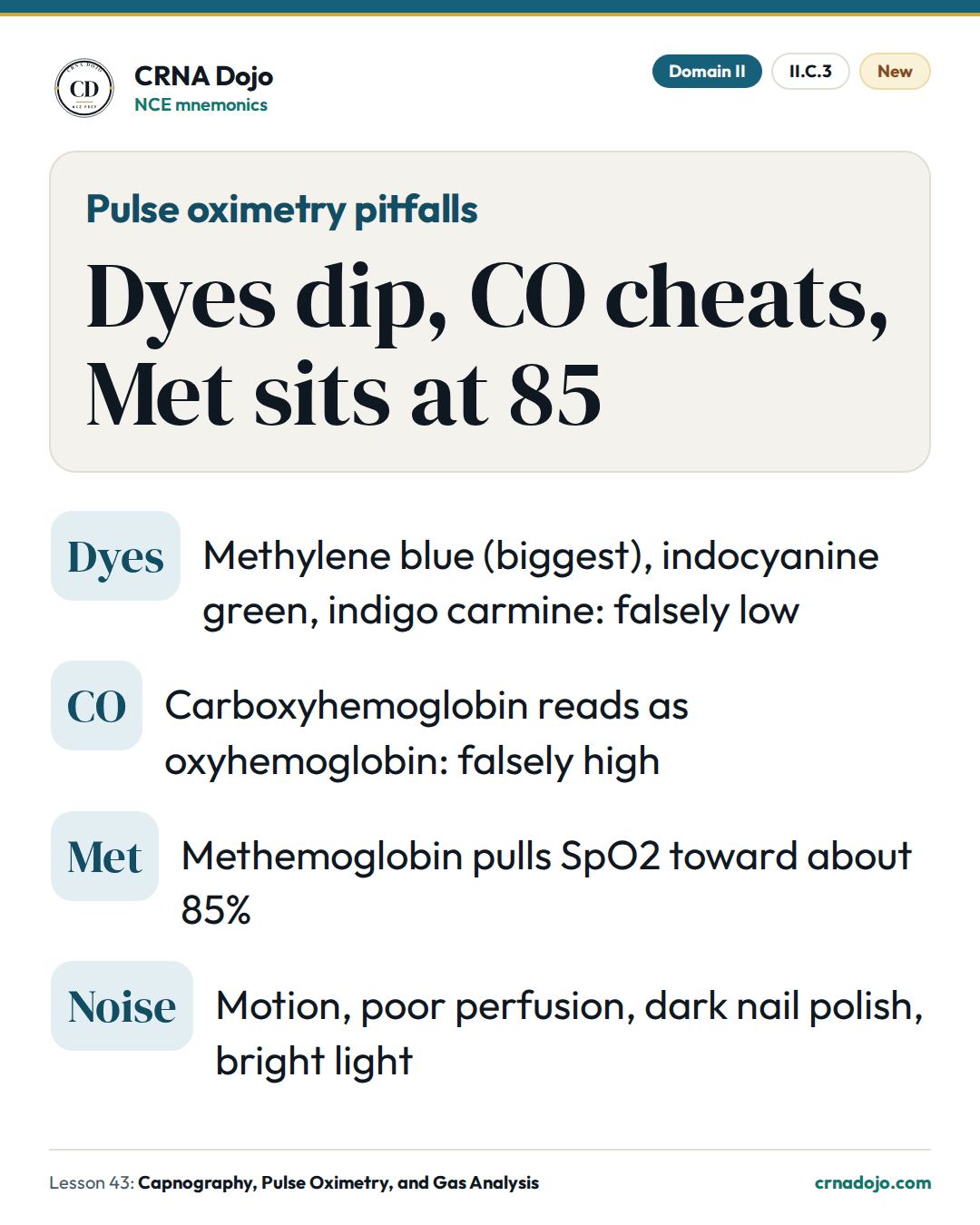
- Pick the right sensor for oxygen, carbon dioxide and the volatile agents, and name the oximeter's blind spots
Your case
OR 6 · Lap sigmoid colectomy · 35 min in
Mrs. R, 62, 78 kg. Insufflation at 15 mmHg. Nothing about the ventilator has changed.
Over two minutes the EtCO2 falls from 38 to 15. The waveform still looks square. It is just shorter.
EtCO2 15
SpO2 96%
BP 74/40
HR 124
Ppeak 22
Hold that thought
- The waveform kept its shape and lost its height. What does that narrow it down to?
- An arterial gas drawn now shows a PaCO2 of 46. How can EtCO2 fall while PaCO2 rises?
- The SpO2 still read 96% a full minute after the pressure dropped. What is the oximeter doing?
You will answer these at the end of the lesson.
Members only
The rest of this lesson is for members
Membership opens all 98 lessons, every cheat sheet and memory card, the full question bank, and simulation exams.
Not ready to join? Free account: take the 50-question diagnostic, see your weakest domain, and get a study plan built around your exam date. No card.
Start free
Free for everyone
Free memory card
Save it to your phone or print it.
On a phone: press and hold a card, then tap Save to Photos.
Inside this lesson
- Start
- The case
- Infrared
- Sampling
- The four phases
- The gradient
- Three patterns
- Waveform reader
- Capnography in CPR
- Pulse oximetry
- Oximetry errors
- Gas analyzers
- ASA standards
- Lock it in
- Board traps
- Cheat card
- 5-question quiz
- Wrap-up